


Quick Info:
- IATA Code: BCN
- ICAO Code: LEBL
- Location: El Prat de Llobregat (approx. 12–15 km southwest of the city center)
- Opened: Since 1918 (at the current location)
- Transport: Metro (L9 Sud), trains (R2 Nord), Aerobús, city buses, taxi
- Parking: Short-term and long-term parking at both terminals, VIP parking
The journey to sunny Catalonia begins here for most travelers. Barcelona-El Prat Airport, officially known as Josep Tarradellas Barcelona-El Prat, is the gateway to the world of Gaudí's architecture, excellent tapas, and endless beaches. As travel luggage specialists at Bagalio, we know that a well-planned trip starts with peace of mind at the airport. In this article, we will guide you through everything you need to know to ensure your trip to and from the airport goes without a hitch.
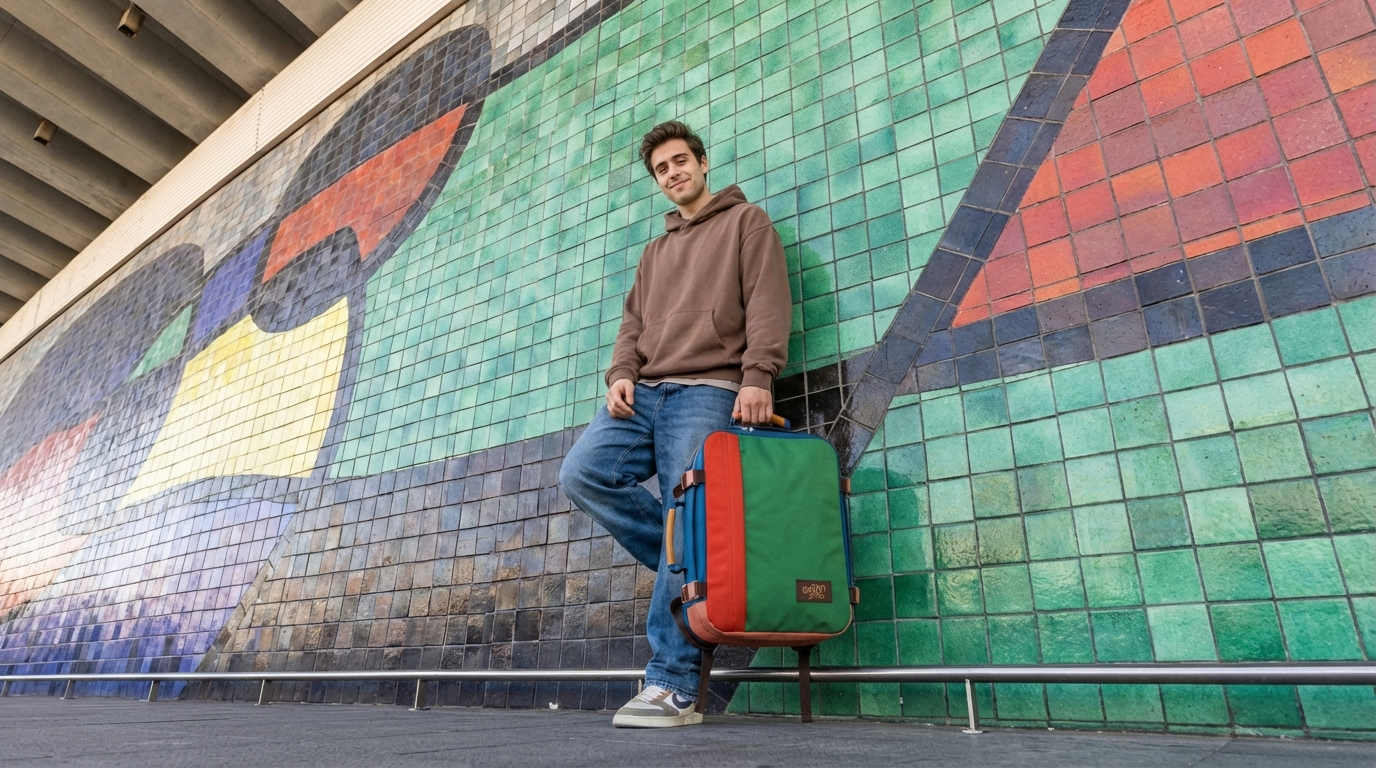
Table of Contents:
- Basic identification and importance of Barcelona-El Prat Airport
- Geographical data and BCN infrastructure
- Transport: How to get to the center
- From arrival at the airport to boarding: step by step
- Services and waiting for your flight
- Comfort for passengers with children and specific needs
- Accommodation nearby
- Final tips from Bagalio
- Frequently Asked Questions (FAQ)
Basic identification and importance of Barcelona-El Prat Airport
Barcelona-El Prat Airport is a key point on the map of European air travel. It is located in the municipality of El Prat de Llobregat and serves as the primary hub for all of Catalonia.
- IATA code BCN: You will see this code on your tickets and luggage tags.
- Location: El Prat Airport is located approximately 12 to 15 kilometers southwest of the center of Barcelona, making it one of the most accessible major airports in Europe.
- Importance: It is the second-largest airport in Spain (after Madrid's Barajas) and a crucial hub for both low-cost and long-haul flights.
Did you know that... since 2019, the airport has borne the name of Josep Tarradellas, a key Catalan politician who became a symbol of the return of democracy? After 38 years in exile, he returned to Barcelona in 1977 and delivered the legendary sentence from the balcony of the palace on Plaça de Sant Jaume: "Ciutadans de Catalunya, ja sóc aquí!" (Citizens of Catalonia, I am here!).
Why the airport is key to the region
For Barcelona and its surroundings, Barcelona Airport represents the main engine of the economy and tourism. Without it, Barcelona would not be one of the most visited metropolises in the world.
- Transport hub: It connects Europe with Latin America, North America, and Asia.
- Tourism: It is the first place millions of tourists visit on their way to see landmarks like the Sagrada Família or Park Güell.
- Logistics: In addition to passenger transport, El Prat plays a significant role in freight transport for the entire Mediterranean region.
The airport in numbers and context
The numbers speak for themselves – Barcelona Airport is among the best. Every year, it handles tens of millions of passengers, which requires precise organization and modern infrastructure.
- Sixth busiest airport: On a European scale, it regularly ranks in the top 10 in terms of passenger numbers.
- Area: It covers a vast area between the coast and the city of El Prat.
- Capacity: Thanks to continuous expansion, it is capable of serving over 50 million passengers annually.
Geographical data and BCN infrastructure
Barcelona-El Prat Airport is a modern complex that is constantly evolving. If you are arriving at the airport, it is important to know which terminal you will land at, as they are several kilometers apart.
- Number of terminals: The airport has two terminals, marked as T1 and T2.
- Terminal 1 (T1): This is the newer and larger terminal, designed by architect Ricardo Bofill. It handles most standard and long-haul airlines.
- Terminal 2 (T2): The older part of the airport, which is divided into sections T2A, T2B, and T2C. Today, it serves primarily low-cost carriers such as Ryanair.
- Schengen area: Both terminals are divided into zones for flights within and outside the Schengen area, which facilitates passport control.
- Runways: The airport has three runways, which allow for smooth operations even during peak hours.
Key carriers and air traffic
Barcelona is home to several major airlines. Thanks to strong competition, flight tickets to this destination are often very affordable, even from Prague or Vienna.
- Home airlines (Hub): The most important carrier here is Vueling, which operates hundreds of flights daily from BCN. Another major player is the company Level (for long-haul flights).
- Low-cost giants: Ryanair has one of its largest bases here, which enables cheap travel throughout Europe.
- Airline alliances: At T1, you will find members of Star Alliance, Oneworld, and SkyTeam.
- Arrivals and departures: Current arrivals and departures can be tracked in real-time on the official airport website or in the mobile Aena application.
Tip: Check out our table of allowed carry-on luggage dimensions and browse our wide selection of carry-on luggage, which we have clearly categorized by their dimensions.
History and interesting facts
The airport has come a long way since its inception. Originally a small airfield, it has transformed into an architectural gem that reflects the ambitions of all of Catalonia.
- Historical milestones: The first airport in the area was established as early as 1916 (El Remolar); it moved to its current location in 1918.
- T1 Architecture: Terminal 1, opened in 2009, is known for its "sword-like" shape and glass walls that let in maximum daylight.
- Joan Miró Mosaic: On the facade of Terminal T2, you will find an iconic ceramic mosaic by the famous Catalan artist Joan Miró, which has been welcoming visitors since the 1970s.
Did you know that... the ceramic mosaic by Joan Miró on the facade of Terminal T2 is part of the artist's vision of a "triple welcome"? Miró wanted to greet visitors to Barcelona from the air (the mosaic at the airport), from the sea (the mosaic on La Rambla boulevard), and from the ground (the statue in Joan Miró Park). Thanks to its colors and size, this wall remains the most popular meeting point for passengers at Terminal T2.
Sustainability and innovation
A modern airport cannot function without an ecological approach. El Prat Airport invests significant funds in reducing its carbon footprint and protecting the surrounding nature.
- Solar energy: The installation of photovoltaic panels on terminal roofs helps cover part of the energy consumption.
- Biodiversity protection: The airport is adjacent to the protected area of the Llobregat River delta and actively participates in its protection.
- Electrification: The network of charging stations for electric vehicles and airport ground equipment is constantly expanding.
Transport: How to get to the center
Choosing the right transport from the airport will save you time and money. There are several options for getting from the airport to the city center, and they differ in price and comfort.
Distance and time
Barcelona Airport is located approximately 15 km southwest of the center, which in an ideal case means a journey of 20 to 35 minutes.
- The exact distance depends on whether you are heading to Plaça de Catalunya or the port.
- Time requirements: Count on at least 30 minutes; in rush hour, it is better to count on an hour.
Public transport
If you are looking for the best value for money, public transport is the clear choice. Barcelona has a high-quality integrated transport system.
- Metro: The L9 Sud metro line connects terminals T1 and T2 with the rest of the network.
Note: some integrated tickets (e.g., T-casual, T-familiar, T-grup) are not valid for travel to/from the Aeroport T1 and Aeroport T2 stations – you need to account for the special airport fare Airport ticket (2026: €5.90). - By train from the airport: The suburban train Rodalies R2 Nord runs from T2. It will take you directly to the main station, Barcelona Sants, or to Passeig de Gràcia. It is the fastest way to the center (approx. 25 min).
- By bus:
- Aerobús (A1 and A2): Special express buses that run every 5–10 minutes from both terminals directly to Plaça de Catalunya. A one-way ticket costs €7.45, a return ticket €12.85 (2026).
- Line 46: A cheap variant of a regular city bus, where standard tickets and the Barcelona card are valid.
- Night buses: Lines N17 (from T1) and N18 (from both terminals) provide transport during night hours.
Individual transport
For those who prefer door-to-door comfort, verified taxi and ride-sharing services are available.
- Taxi: You will find stands in front of both terminals. The price to the center is between €30–40 (including airport surcharges).
- Uber and Cabify: They operate reliably here, but have designated specific pickup points (often in parking garages).
- Car rental: Within the terminal, you will find counters for all major car rental companies.
Parking
If you are driving to the airport in your own car, you have thousands of parking spaces available in various price ranges.
- Short-term parking: Ideal for dropping off or picking up passengers. The first 10 minutes are usually free (check current conditions by terminal).
- Long-term parking: Located a bit further from the terminals, but connected by a free shuttle bus.
- Parking at T1 and T2: Each terminal has its own parking garages with direct access to the departure hall.
From arrival at the airport to boarding: step by step
- Terminal check: Always check your ticket to see if you are flying from T1 or T2. If you make a mistake, a free green shuttle bus runs between the terminals (the journey takes 10–15 min).
- Luggage check-in: Arrive at the airport at least 2 hours before departure (3 hours for long-haul flights). Find your airline on the information boards.
- Security check: Prepare liquids up to 100 ml in a transparent bag and remove electronics. Terminal 1 usually has more security checkpoints, so the process is often smoother.
- Passport control: Applies only to flights outside the Schengen area (e.g., to the UK or USA).
- Way to the gate: Follow the signs. In T1, the distances between gates can be significant, so leave yourself some extra time.
Tip: Keep your liquids ready in transparent bottles so you can pass through security without delaying yourself or others. You can find them in our Travel essentials category. For more information on what you are and are not allowed to take on board the plane, you can read the article in our advice section.
Services and waiting for your flight
Waiting for your flight doesn't have to be boring. Barcelona El Prat Airport offers services on the level of a five-star hotel.
Transfer potential
Barcelona is a popular place for layovers. If you have more time between flights, the airport offers you every comfort.
- Terminal connection: As mentioned, a free shuttle bus is available 24/7.
- Layover tips: If you have more than 6 hours, you can manage a quick tour of the city thanks to the fast connection by Aerobús.
- Luggage storage: You will find it at both terminals. Ideal if you want to explore Barcelona without heavy suitcases.
Lounges
For those looking for peace to work or relax, luxury lounges with refreshments and showers are prepared.
- Pau Casals (T1): Often rated as one of the best lounges in the world. Intended for flights within the Schengen area.
- Joan Miró (T1): For passengers outside the Schengen area.
- Canudas (T2): A quiet oasis in the busier "low-cost" terminal.
- Entry: Access is available to cardholders (e.g., Priority Pass), business class passengers, or you can purchase a one-time entry.
Gastronomy and shopping
From a quick sandwich to a luxury dinner – the food offer at Barcelona Airport is as diverse as in the city itself.
- Gastronomy: Try local specialties at a "Tapas bar" or play it safe with international chains like McDonald's or Starbucks.
- Shopping and Duty-Free: Huge zones with perfumes, alcohol, and cosmetics are complemented by boutiques of brands like Desigual, Mango, or Massimo Dutti.
- Local specialties: Don't forget to buy olive oil, wine, or traditional Spanish jamón at the last minute.
Basic amenities
The airport thinks of everything you might need during your journey.
- Wi-Fi: Free high-speed connection is available throughout the area under the "Airport Free Wifi Aena" network.
- Currency exchange and ATMs: Distributed throughout the terminal, but expect less favorable rates.
- Pharmacies: Located in the departure halls of both terminals in case of sudden illness.
Comfort for passengers with children and specific needs
- Children's corners: In both terminals, you will find play zones for children of all ages.
- Parent rooms: Quiet places for breastfeeding and changing are standard.
- Stroller rental: Families with small children can also use free airport cart rentals equipped with a child seat (subject to availability, via Aena information desks).
- PRM Assistance: Persons with reduced mobility can request assistance for free (we recommend at least 48 hours in advance via the Aena website). The entire international airport is fully wheelchair accessible.
Accommodation nearby
- Sleep & Fly: Hotel rooms directly in the T1 transit zone.
- Hotels with shuttle service: In the immediate vicinity (El Prat de Llobregat), you will find hotels like Tryp Barcelona Aeropuerto or B&B Hotel Barcelona Viladecans, which offer free transport.
Final tips from Bagalio
- Watch the time: Barcelona is huge and security checks can be lengthy in the season. Be at the airport on time.
- Tickets: Distinguish between cards. The Hola Barcelona Travel Card is ideal for unlimited public transport travel (including the metro to the airport). However, if you also want free entry to museums and other discounts, choose the more comprehensive Barcelona Card. Both cards are valid for travel from the airport (except for the Aerobús).
- Luggage: Don't forget to secure your suitcase with a lock. If you are looking for new durable travel luggage, check us out at Bagalio!
Frequently Asked Questions (FAQ)
How to get from Barcelona Airport to the center the cheapest way?
The cheapest option is the city bus line 46 (during the day) or lines N17/N18 (at night), where you can use regular integrated tickets like T-casual (if you already have them) or single fares.
Is there free transport between terminals T1 and T2?
Yes, a free shuttle bus runs continuously (24/7) between terminals T1 and T2. The journey takes approximately 10–15 minutes.
Where can I find the train stop at the airport?
The train station is located at Terminal 2. If you arrive at Terminal 1, you must first take the shuttle bus to T2 and then walk through the glass bridge to the platform.
Is a regular ticket valid on the metro to the airport?
No, a special fare applies to the L9 Sud line heading to the airport. However, if you have multi-day tickets like the Hola Barcelona Travel Card, the trip to the airport is included in them.
What is the nearest airport to Barcelona besides El Prat?
If you cannot find suitable flights to El Prat, you can use Girona Airport (approx. 100 km north) or Reus Airport (approx. 100 km south). Both airports are connected to Barcelona by bus lines.


