


Quick Info:
- IATA Code: MAD
- ICAO Code: LEMD
- Location: Barajas district, 13 km northeast of Madrid city centre
- Open: 24 hours a day
- Transport: Metro (Line 8), Cercanías trains (C1, C10), buses (Express 203), taxi, Uber
- Parking: Short-term and long-term in all terminals (P1, P2, P4)
Adolfo Suárez Madrid-Barajas Airport is the main gateway to the Spanish capital and one of the most important transport hubs in the world. Whether you're flying to Madrid for sightseeing, football, or just transiting for a long-haul connection, this guide will help you navigate its modern and expansive facilities.
Contents:
- Basic Identification and Significance of Adolfo Suárez Madrid-Barajas Airport
- Geographical Data and Infrastructure
- Key Carriers and Air Traffic
- History and Interesting Facts
- Transport: How to Get to Madrid City Centre
- Parking at the Airport
- From Arrival at the Airport to Boarding: Step-by-Step
- Services and Waiting for Your Flight
- Comfort for Children and People with Specific Needs
- Accommodation Nearby
- Frequently Asked Questions (FAQ)
Basic Identification and Significance of Adolfo Suárez Madrid-Barajas Airport
The international airport in Madrid has officially been named Aeropuerto Adolfo Suárez Madrid-Barajas since 2014, in honour of Spain's first democratically elected prime minister. With its size and number of passengers handled, it ranks among the most important airports in the world and serves as a key bridge connecting the Old Continent with the New World.
- Significance: It is the largest airport in Spain and the main hub for flights between Europe and Latin America.
- Location: It is located approximately 13 km northeast of the city centre in the Barajas district.
- MAD Code: Under this code, you will find all flights and flight schedules to the Spanish capital.
- Operator: The airport is operated by Aena, which ensures the smooth running of all operations and services for passengers.
Geographical Data and Infrastructure
Madrid Airport features four main terminals and one satellite building, designed to handle the immense volume of international and domestic flights. Each terminal has its specific focus and serves different airlines, which aids efficient operation.
- Terminals T1, T2, T3: The older part of the airport, where buildings are within walking distance of each other. Terminal 1 is primarily dominated by low-cost carrier Ryanair and non-Schengen flights.
- Terminal 4 (T4) and T4S: A modern architectural masterpiece and one of the largest terminals in the world. Terminal 4 is primarily used by Iberia and its Oneworld alliance partners.
- Runways: Madrid Airport uses four runways, allowing for a high frequency of departures and arrivals even during peak times.
- Connections between buildings: Free 24/7 shuttle buses operate between terminals, though the frequency may vary depending on the time of day. For some transfer connections (transit), a boarding pass may be required. The journey takes approximately 10–15 minutes.
How do I know the correct terminal? Always refer to the information on your boarding pass or booking confirmation – Madrid-Barajas uses designations T1, T2, T3, and T4 (including the satellite T4S). If you are unsure, you can quickly verify it in the official app or on the airport's website by flight number.
Key Carriers and Air Traffic
As the main airport in Spain, Barajas is home to several major airlines that operate their main bases from here. Thanks to a strong presence of global alliances, Madrid Airport offers connections to hundreds of destinations across all continents.
- Iberia: The national carrier has its main hub at Terminal 4 and handles most long-haul flights across the Atlantic.
- Air Europa: The second most important Spanish airline most frequently operates from Terminals T1 and T2, focusing on both European and overseas routes.
- Low-cost carriers: Ryanair and Vueling play a significant role here, allowing you to find cheap flights even at the last minute.
- Alliances: Oneworld (led by Iberia) and SkyTeam (Air Europa) alliances have a strong presence here, which facilitates connecting flights for transit passengers.
Tip: Flying with low-cost carrier Ryanair? Remember that carry-on baggage dimensions vary between different airlines. Check out our comprehensive overview of baggage dimensions and choose the right cabin suitcase that will pass inspection without problems.
History and Interesting Facts
The history of this airport dates back to 1928, but its modern face was primarily defined by the opening of Terminal T4 in 2006. This structure became a symbol of the capital's development and has won numerous prestigious design awards.
- Architecture: Architects Richard Rogers and Antonio Lamela are behind the visual design of the iconic Terminal 4.
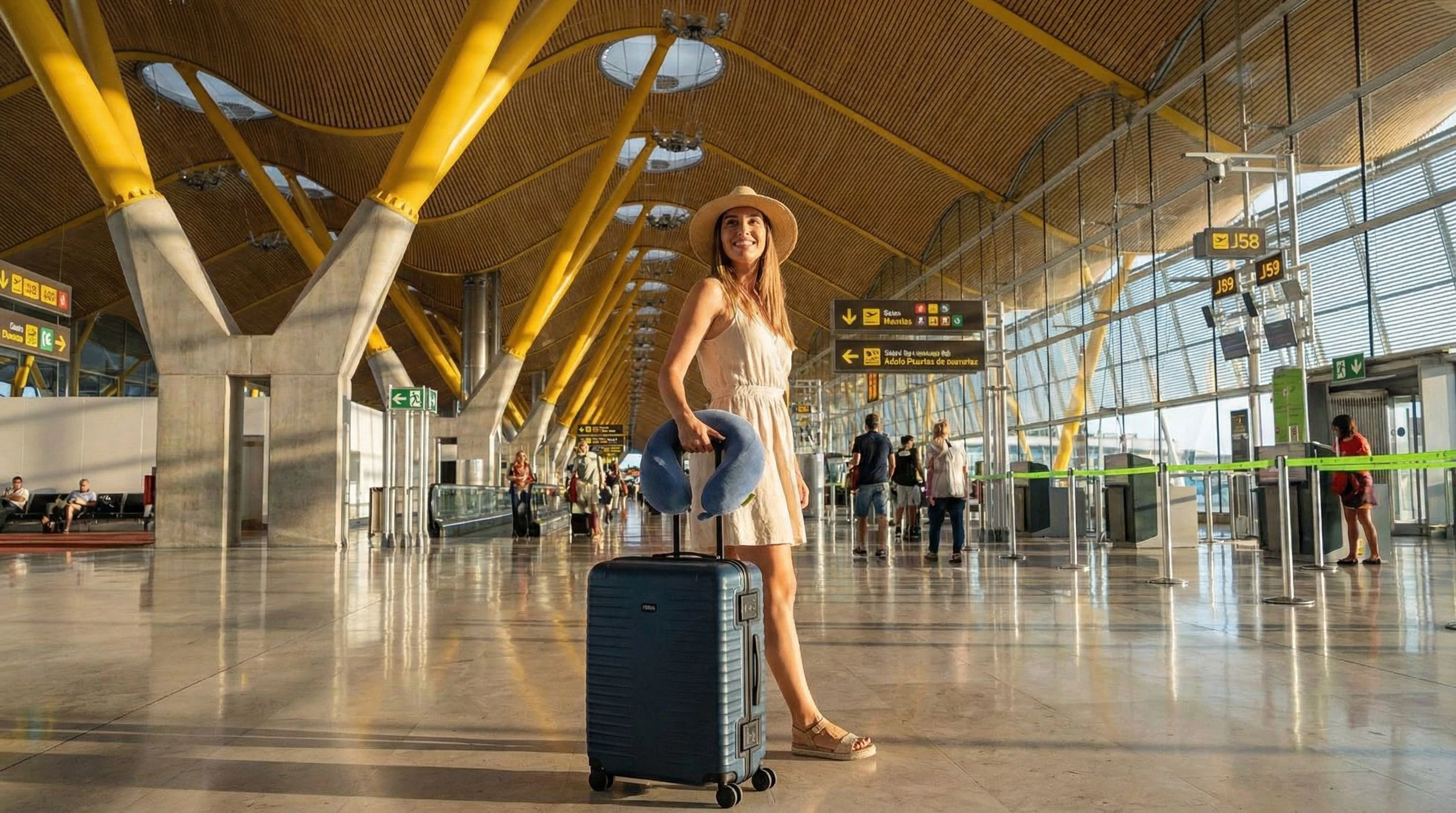
- Unique design: The wave-shaped bamboo roof and the use of natural light create a calming and aesthetic experience for passengers.
- Name: The name Adolfo Suárez was added to the airport's name in 2014 as a mark of respect for a significant figure in Spanish democratic history.
- Sustainability: The airport, managed by Aena, actively implements innovations in energy saving and water recycling throughout the complex.
Did you know that... Adolfo Suárez, after whom the airport is named, was one of the most important figures in Spanish history? He was the first democratically elected prime minister after General Franco's dictatorship and played a key role in the so-called transition to democracy (Transición). It was thanks to his ability to negotiate and reconcile a divided society that Spain embarked on a path of freedom and modernization.
Transport: How to Get to Madrid City Centre
Getting from the airport to the city centre is very easy thanks to a sophisticated public transport system that operates efficiently and at reasonable prices. The distance from the centre varies by terminal – approximately 13 km to T1–T3 and up to around 20 km to T4.
Public Transport
- Metro (Line 8): The price of a single ticket usually consists of a basic fare based on the number of stations travelled (approx. €1.50–€2) and an airport supplement of €3. In total, you will pay approximately €4.50–€5 for a single journey (according to the current public transport tariff). You can reach the interchange station Nuevos Ministerios from the airport in about 15–20 minutes; for the absolute city centre, you will need to factor in a transfer and a longer journey.
- Train (Cercanías): Lines C1 and C10 run directly from T4 to Atocha main station and Príncipe Pío. It is often free for passengers with national AVE tickets.
- Express Bus 203: The yellow bus marked Express Aeropuerto runs 24 hours a day, from Atocha during the day and from Cibeles at night. The journey takes approximately 40 minutes.
- Local Buses: Line 200 goes to Avenida de América and Line 101 to the Canillejas area.
Private Transport
- Taxi: A fixed fare of €33 (without surcharges) applies between the airport and the area within the M-30. Outside the M-30, the price is determined by the taximeter according to the tariff.
- Ride-sharing: Services like Uber or Cabify have designated pick-up points at the airport, and the price varies based on demand.
- Car Rental: Vehicle rental services are available in all terminals; we recommend early online booking.
Parking at the Airport
If you are planning to drive to the airport, operator Aena offers several parking options that suit both those who are just dropping off or picking up passengers and those flying off on holiday.
- Short-term parking (P1, P2, P4): Ideal for quick drop-offs or pick-ups directly at the terminal buildings.
- Long-term parking: Located a little further away, but it is the cheapest option and connected by a free shuttle bus.
- VIP parking: For discerning clients with a valet service that takes your car directly at the entrance to the departure hall.
- Booking: We recommend booking parking online in advance through the official website to save a significant portion of costs.
From Arrival at the Airport to Boarding: Step-by-Step
The check-in, security, and departure process at Barajas Airport is straightforward, but due to its vastness (especially in the case of T4), we recommend arriving at least 2.5 hours before your flight.
- Arrival at the airport: Verify whether you are departing from T1, T2, or T4 to choose the correct metro stop or car park.
- Baggage check-in: Find your airline's check-in counter. If you only have carry-on baggage, you can head straight to security.
- Security check: Prepare your boarding pass and liquids in a transparent bag. Be aware of prohibited items.
Tip: Find out what you can and cannot have in your carry-on baggage. We've prepared an article about it in our advice section! - Passport control: If you are flying outside the Schengen Area, document control follows.
- Journey to the departure gate: At Terminal 4, be aware that the journey to the gates in the satellite building T4S can take up to 20 minutes by automatic underground train (the train ride itself is short, but transfers, potential checks, and waiting can take time).
- Boarding the aircraft: Follow the information screens displaying current departure gates.
Tip: Have a long layover in Madrid for a flight to Latin America? Don't forget to pack a travel pillow in your carry-on bag.
Services and Waiting for Your Flight
Adolfo Suárez Madrid-Barajas Airport is known for its high level of services. Time spent waiting for your connection here will pass very quickly thanks to the myriad of entertainment options.
- Lounges: Each terminal has several VIP lounges (e.g., Sala VIP Puerta de Alcalá or Cibeles) with premium refreshments. If you are interested in spending your waiting time in a lounge, check the airport's current offerings.
- Gastronomy: From fast food to luxury restaurants, cafes, and traditional Spanish tapas bars.
- Shopping: Extensive Duty-Free zones offer cosmetics, alcohol, and local delicacies such as jamón and Spanish wines.
- Basic amenities: Free Wi-Fi, ATMs, currency exchange, pharmacies, and luggage storage are all available.
- Culture and art: Art installations and exhibitions reflecting Madrid's rich culture can be seen throughout the airport.
Comfort for Children and People with Specific Needs
The airport is fully accessible and very family-friendly. The commitment to maximum comfort for all passengers is evident at every step.
- Children's play areas: Modern playgrounds and quiet zones for parents with young children are available in the transit areas.
- Stroller rental: If you checked in your stroller, you can borrow an airport stroller for free to move around the terminal.
- PRM Assistance: Assistance service for persons with reduced mobility must be booked at least 48 hours in advance through the Aena system.
Accommodation Nearby
If you have a long layover or an early morning departure, you will find a wide range of accommodation options near Madrid Airport to suit every budget.
- Hotels with shuttle bus: Many hotels in the Barajas district offer shuttle transport between the airport and the hotel (conditions and potential cost vary by accommodation).
- Air Rooms: The Air Rooms hotel is located directly in Terminal 4, where you can rent a room for a few hours to refresh.
- Availability: Thanks to the metro and night buses, you can easily find accommodation even in the wider Madrid city centre.
Frequently Asked Questions (FAQ)
What's the cheapest way to get from the airport to the city centre?
The cheapest option is usually city buses (Line 200) for a standard public transport fare, if you don't need to go directly to Atocha main station.
Which terminal does Iberia use?
Iberia primarily uses the modern Terminal 4 and its satellite building T4S.
How long does it take to transfer between T1 and T4?
By free shuttle bus, the journey between terminals takes approximately 10 to 15 minutes.
Is there Wi-Fi at Madrid Airport?
Free Wi-Fi is available throughout the airport; after a quick registration/account verification, connection is available without time limits.
Does transport from the airport operate at night?
Yes, night bus services are available, and taxi services operate 24 hours a day.
We wish you a pleasant journey, and remember that with quality luggage from Bagalio, your travels to Adolfo Suárez Madrid-Barajas Airport will be even more enjoyable!


