


Quick Info:
- IATA/ICAO Code: AGP / LEMG
- Location: 8 km southwest of Málaga, 5 km north of Torremolinos
- Open: 24 hours a day (Note: The airport is open nonstop, but at night, terminal access may be restricted to passengers with a valid flight ticket/boarding pass.)
- Transport: Train (Renfe C1), Express Bus A, Taxi, Uber
- Parking: P1 (General), P2 (Express), VIP, Long-stay
- Website: aena.es
Are you heading for a vacation in sunny Andalusia? Your gateway will likely be Málaga Airport, a strategic hub for all lovers of southern Spain. Whether you are heading to the hometown of Pablo Picasso for art or to the beaches of the Costa del Sol for relaxation, we have prepared a detailed guide to make your arrival and departure completely stress-free.
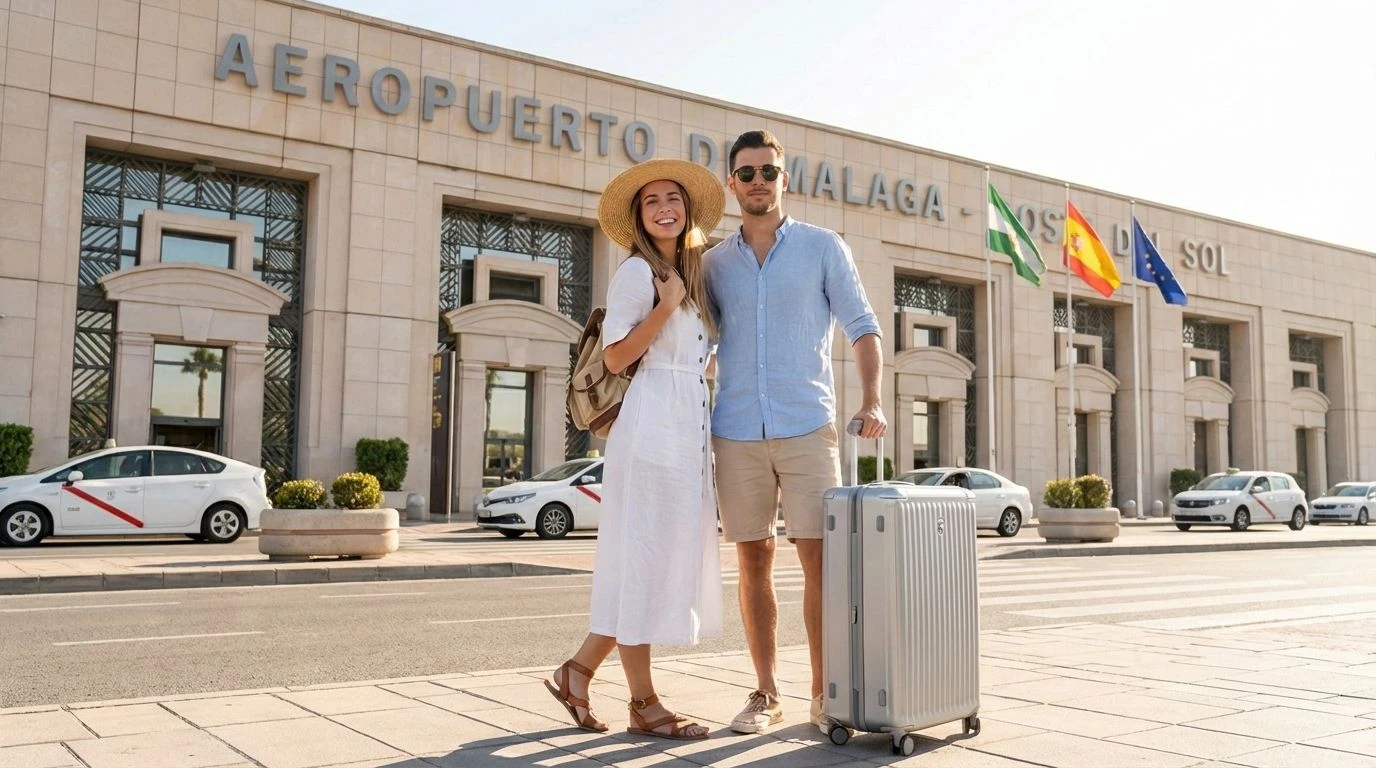
Table of Contents:
- Basic Identification and Significance
- Geographic Data and Infrastructure
- History and Interesting Facts
- Transport: How to Get to the Center
- Parking
- From Airport Arrival to Boarding
- Services and Waiting for Your Flight
- Comfort for Travelers with Children and Specific Needs
- Accommodation Nearby
- Final Tips
- Frequently Asked Questions
Basic Identification and Significance
Málaga-Costa del Sol Airport is the main international airport serving the Costa del Sol area. It is a key hub not only for summer vacations but also for year-round tourism in the Andalusia region. Thanks to its location and capacity, it connects southern Spain with more than 60 countries worldwide.
- Significance: It is the main gateway for tourists heading to resorts like Marbella, Torremolinos, or Fuengirola.
- History of the Name: Many locals still call it the Pablo Ruiz Picasso Airport, which was its official name in the past.
- Regional Role: The airport is important for tourism in the entire province and serves as a transport hub for millions of visitors annually.
The Airport in Numbers and Context
To get a better idea of the size and activity at this airport, let's look at the statistics. It is not a small provincial airport, but a modern colossus that ranks among the best in Spain.
- Market Position: It is officially stated that the Pablo Ruiz Picasso Airport is the fourth busiest airport in Spain (after Madrid, Barcelona, and Palma de Mallorca).
- Capacity: The airport handles approximately 25 million passengers annually (breaking records in recent years), making it one of the busiest aviation gateways in Spain.
- Dominance: It represents approximately 80% of all international traffic in Andalusia.
Geographic Data and Infrastructure
The airport's location is ideal for travelers. It is located in the immediate vicinity of the coast and major highways, ensuring a quick transfer to your final destination.
- Exact Location: The airport is located 8 km southwest of the city of Málaga and 5 km north of the town of Torremolinos.
- Terminals: The airport has three terminals (T1, T2, T3), which are interconnected and function as a single unit. Most flights are handled through the modern T3.
- Runways: It has two runways, allowing for smooth operations even during peak hours.
- Codes: In flight booking systems, you will find it under the code AGP; the ICAO code is LEMG.
Key Carriers and Air Traffic
Thanks to the popularity of the Costa del Sol, a huge number of airlines fly here, from low-cost to legacy carriers. You can get here very easily from Prague via a direct flight.
- Smartwings: The Czech airline Smartwings operates regular direct flights from Prague (PRG), especially during the summer season.
- Ryanair: The Irish low-cost carrier Ryanair has one of its bases here and offers flights to dozens of European cities.
- Other Carriers: Frequent carriers include easyJet, Vueling, Iberia, and Norwegian.
- Transatlantic Flights: During the season, connections to North America and the Middle East are also available.
Tip: Are you flying with a low-cost airline like Ryanair or easyJet? Save on expensive checked baggage and choose from our selection of carry-on backpacks that exactly meet their strict dimension limits.
History and Interesting Facts
The airport has a rich history dating back to the early 20th century. Since its founding in 1919, it has undergone many transformations that reflected the growing interest in Spain as a tourist destination.
- Origins: It was one of the first Spanish airports and originally served as a stop on the Toulouse – Barcelona – Alicante – Málaga – Casablanca route.
- Picasso: For many years, it bore the name of the famous painter Pablo Picasso, who was born in Málaga.
- Architecture: Terminal 3, opened in 2010, is an architectural gem with high ceilings and glass walls that let in the Andalusian sun.
Sustainability and Innovation
In recent years, the airport operator (Aena) has focused on reducing its ecological footprint and introducing modern technologies for smoother check-in.
- Quiet Terminal: The airport strives to minimize noise pollution in the terminals by limiting public address announcements.
- Solar Energy: Use of photovoltaic panels to cover part of the energy consumption.
- Biometrics: Testing biometric systems for faster passage through security checks.
Transport: How to Get to the Center
Transport from the airport to the center of Málaga or surrounding resorts is smooth. You can choose from train, bus, or taxi, and everything is clearly marked.
Distance and Time
Thanks to the short distance from the city, you don't waste time on long transfers. You are in the center or on the beach in literally a few minutes.
- To Málaga Center: The train journey takes about 12 minutes, by car about 15–20 minutes (depending on traffic).
- To Torremolinos: The journey takes less than 10 minutes.
- Location: The complex is located approx. 8 km southwest of the center.
Public Transport
The most efficient way of transport is undoubtedly the suburban train. It is fast, cheap, and reliable. Buses are a great alternative if you are heading to places where the tracks do not lead.
- Train (Renfe Cercanías): Line C1 connects the airport with the center of Málaga (Centro Alameda station) and, in the other direction, with the resorts of Torremolinos, Benalmádena, and Fuengirola.
- Trains run every 20 minutes.
- The station is located directly opposite the T3 arrivals hall.
- A ticket costs approximately €1.80 – €2.70 depending on the zone.
- Bus (Avanzabus/EMT):
- Line A Express: Express bus to the center of Málaga. Stops at T3. Price approx. €4.
- Intercity connections: The Avanzabus company offers direct connections from the airport to cities like Marbella, Estepona, or Algeciras.
- Timetables: We recommend checking current departure times, especially for night arrivals.
- Prices may change, check before traveling!
Individual Transport
If you prefer comfort and privacy, or have a lot of luggage, a taxi or car rental is an ideal choice.
- Taxi: You will find the taxi rank in front of the T3 arrivals hall. A taxi to the center costs approximately €20–25, but always according to the tariff/taximeter and any surcharges.
- Uber/Cabify: Uber and Cabify apps also operate at Málaga Airport, which can be cheaper than a classic taxi.
- Car Rental: Dozens of car rental companies are located in the arrivals hall. Renting a car is ideal if you want to explore all of Andalusia. We recommend making a reservation online in advance.
Tip: Are you planning a road trip along the Costa del Sol? To keep your things organized, we recommend using suitcase organizers. Packing and unpacking at every stop will be easier and clearer.
Parking
Are you arriving at the airport in your own car? There are several parking options, from express spaces to long-term parking for your vacation.
- P1 General: Main parking directly at terminals T2 and T3, ideal for stays up to 4 days.
- Express Parking: For quick drop-off and pick-up of passengers (free for up to 10 minutes) directly at departures (P2).
- Long-stay: Long-term parking with shuttle service, suitable for longer vacations, most cost-effective.
- VIP Parking: Premium service with valet parking.
From Airport Arrival to Boarding: Step by Step
The check-in process at Málaga Airport is standardized and efficient. The terminals are spacious, but expect larger crowds during the season.
- Arrival: Follow the "Salidas / Departures" signs. Most flights are handled from T3.
- Check-in: You will find counters in the main hall of T3. If you have a boarding pass on your mobile and only carry-on luggage, go straight to the security check.
- Security Check: Located on the first floor. Prepare your liquids and electronics.
- Boarding: After passing through the duty-free zone, follow the information boards. Departure gates are marked with letters B, C, and D.
Services and Waiting for Your Flight
You can make waiting for your departure more pleasant with shopping, good food, or relaxation in a lounge. The airport offers first-class facilities.
Transfer Potential
Málaga is not a typical transfer hub like Madrid or Frankfurt, but transfers are possible here and relatively simple thanks to the interconnection of the terminals.
- Compactness: All departure gates are accessible on foot after passing through the security check.
- Layover: If you have more than 4 hours for your transfer, you can take the C1 train to visit the city center.
Lounges
For more demanding travelers or loyalty card holders, comfortable facilities are available.
- Sala VIP: The main lounge is located in the boarding zone, on the 2nd floor. It offers refreshments, Wi-Fi, comfortable armchairs, and peace. Entry is possible with a Priority Pass or for a one-time fee.
Gastronomy
You won't leave hungry. The offer ranges from fast food to restaurants with local cuisine.
- Fast Food: Burger King, Starbucks, Upper Crust.
- Local Flavors: Tapas bars and restaurants where you can taste specialties from Málaga one last time before departure.
- Cafes: A number of cafes scattered throughout the terminal.
Shopping
The duty-free zone is extensive and offers a classic assortment as well as local products.
- Duty-Free: Alcohol, perfumes, cosmetics.
- Local Products: Olive oils, wines from the region, hams, and souvenirs with Picasso motifs.
- Fashion: Stores of brands such as Desigual, Victoria's Secret, GAP, and others.
Basic Amenities
Services that make traveling easier are a matter of course.
- Wi-Fi: Unlimited and free throughout the airport area ("AIRPORT FREE WIFI AENA" network).
- Pharmacy: Located in the public area of the T3 departures hall.
- Luggage Storage: Available in the arrivals hall (ground floor of T3).
- Currency Exchange and ATMs: Distributed throughout the terminal.
Culture and Art
The airport bore the name of Pablo Picasso, and art has its place here. You will often come across temporary exhibitions or interesting installations in the terminal areas that remind you of the cultural wealth of the region.
Did you know that... right in the airport area, there is an Aviation Museum (Museo Aeronáutico)? You can see historical planes, an old control tower from the 1940s, and learn more about the beginnings of aviation in Spain. Admission is free for all visitors!
Comfort for Travelers with Children and Specific Needs
The airport thinks of all groups of travelers, including families with children and people with health restrictions.
Children's Corners and Family Facilities
Traveling with children can be demanding, but in Málaga, you will find facilities that make it easier for you.
- Children's Zones: In the non-public area, playgrounds are available to shorten the wait.
- Strollers: Possibility to borrow airport strollers after passing through security.
- Changing Rooms: A sufficient number of rooms for parents with children with all equipment.
Accessibility for Passengers with Reduced Mobility (PRM)
The "Sin Barreras" (Barrier-Free) assistance service is at a high level.
- Booking: Assistance must be booked at least 48 hours before departure with your airline or via the Aena website.
- Meeting Points: There are clearly marked meeting points at the airport where an assistant will pick you up.
- Accessibility: The entire airport (elevators, toilets) is fully wheelchair accessible.
Accommodation Nearby
If you have an early morning departure or a late arrival, accommodation near the airport might come in handy.
- Holiday Inn Express Málaga Airport: The closest hotel, accessible by bus or a short taxi ride.
- Ibis Budget Málaga Aeropuerto: An affordable option just a short distance from the airport.
- Hotels in Torremolinos: Thanks to the train, you are in the resorts in 10 minutes, where the selection of hotels is huge.
Final Tips
Finally, we have several "insider" tips for you that you won't read in regular guides, but they can save you time and money.
- Water: Behind the security check, there are water fountains where you can refill your water bottle for free.
- Terrace: In terminal T3, there is a glass observation deck overlooking the tarmac, great for spotters and children.
- Buying Tickets: Buy Renfe train tickets at the machines in the arrivals hall; they accept cards and cash.
- City: If you have time, go to the center to the Mercado Central de Atarazanas market; it is a culinary experience just a short walk from the train stop.
Frequently Asked Questions
What is the name of the airport in Málaga?
The official name is Málaga-Costa del Sol or Pablo Ruiz Picasso Airport (an older name that is still used).
How far is the airport from the center?
The airport is 8 km southwest of the city of Málaga.
Does a train run from the airport?
Yes, the C1 train line runs directly from terminal T3 to the center of Málaga and to coastal resorts.
How much does a taxi to the center cost?
The price is around €20–25; it may be higher at night and on weekends.
Is there luggage storage at the airport?
Yes, luggage storage is available on the ground floor of terminal T3.


