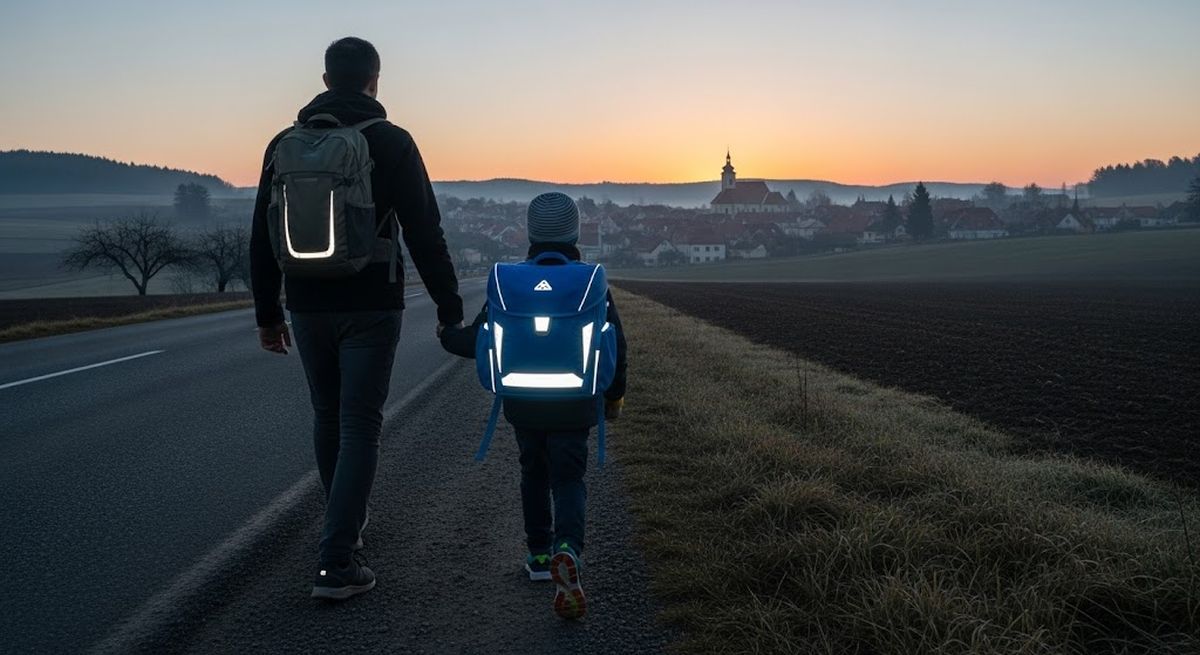
Imagine it is early morning and your child is getting ready for school. It is still dark outside the window and visibility is minimal. Drivers rushing to work have only a few seconds to spot a pedestrian in the morning gloom. If your schoolchild is not wearing reflective elements, they become practically invisible to them. And that is a huge risk. That is exactly why reflective elements are not just a fashion accessory, but a literal life-saver. They are a cheap and simple way to significantly increase safety, not only for children but also for adults. In this article, we will take a detailed look at when and where you must wear them, what types exist, and why they should be an essential part of your gear, whether you are a pedestrian, runner, cyclist, or a parent who wants to ensure the safety of their children on the way to school.
Contents:
- Why are reflective elements essential?
- Who must use reflective elements and when?
- Types of reflective elements and how to use them correctly
- Reflective elements for children: Safety first
- Which reflective elements to use for maximum visibility?
- Reflective materials and their properties
- Care for reflective elements
- Frequently Asked Questions (FAQ)
- Wear reflective elements and help prevent accidents
Why are reflective elements essential?
The risk of a traffic accident increases rapidly in low-light conditions. Traffic accident statistics speak clearly: a large portion of collisions with pedestrians happens at night or at dusk, often outside illuminated sections. A pedestrian in dark clothing without reflective elements is visible to a driver from only 18 meters away. At 90 km/h, that is less than a second! That is time that is absolutely insufficient for any reaction. In contrast, a pedestrian with reflective elements is visible from a distance of up to 200 meters, which gives the driver enough time to safely slow down or drive around.
This simple math shows why using reflective elements is so crucial. It is a basic principle of passive safety – a set of measures that reduce the risk of injury in the event of an accident. And legislation takes this into account. Act No. 361/2000 Coll., on road traffic, clearly defines when a pedestrian must wear a reflective element. This obligation applies outside the municipality during low visibility. Ignoring this rule can lead to a fine, but above all, you are endangering your own life.
Who must use reflective elements and when?
Let's clarify. Who and under what conditions should think about reflective accessories?
Obligation for pedestrians
As already mentioned, mandatory reflective elements for good pedestrian visibility are set by law. Specifically, this concerns situations where a pedestrian moves outside a municipality on a road where there is no sidewalk and no sufficient lighting (i.e., during low visibility). In practice, this means that if you are walking on the road in the dark or fog, you must be visible. In a municipality where there is public lighting and sidewalks next to the road, wearing reflective elements is not mandatory, but it is highly recommended. Even at a pedestrian crossing, a driver can overlook a darkly dressed person if, for example, they are blinded by an oncoming car.
Obligation for cyclists
For cyclists, the obligation relates more to the technical equipment of the bike. These are primarily reflectors on pedals, in the wheel spokes, and on the front and rear of the bike. However, for your own safety (especially if you ride in heavy traffic), it is very wise to also get reflective elements on clothing. This can be reflective bands on ankles, a reflective jacket, or a backpack. Whether you are moving on a bike path or on the road, increased visibility is absolutely essential.
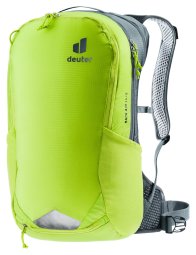
Tip: Cyclists will certainly appreciate practical cycling backpacks that already have reflective elements placed on them.
Other road users
Reflective elements should also be used by others who move near roads or in unlit areas:
- Runners and skaters: They move faster than pedestrians, so the need for visibility is even more urgent. A combination of reflective elements on clothing and accessories is ideal.
- People with strollers: Placing reflective elements on a stroller is absolutely key. Don't forget about yourself either!
- Dog owners: There are reflective collars and leashes that ensure your four-legged friend is also visible.
Tip: Remember that low visibility on roads does not only come at night, but also during rain. An elegant solution can be a backpack rain cover in a neon color with reflective printing.

Types of reflective elements and how to use them correctly
There is not just one type of reflective element. There are many on the market, and each has its advantages. Here is an overview of the most important ones:
| Type of element | Where to use | Advantages | Disadvantages |
| Reflective vest | Over outer clothing | Highest visibility, large surface area | Can be bulky, not always aesthetic |
| Reflective bands/straps | On arms, ankles, backpack | Lightweight, portable, universal | Smaller surface area, can shift |
| Reflective stickers | On helmet, backpack, stroller | Discreet, permanent, water-resistant | Smaller surface area, harder to remove |
| Reflective keychains | On backpack, keys | Fun design, easy handling | Small surface area, can get lost |
Reflective vests: The cornerstone of visibility
Reflective vests are one of the most effective and at the same time simplest solutions. They are mostly made in bright, fluorescent colors (yellow, orange), which increase visibility even in daylight, and are supplemented with reflective stripes. The vest should meet the EN ISO 20471 standard, which defines visibility classes based on the size and type of reflective and fluorescent material. For general use by pedestrians, a class 2 vest is more than enough, while for road workers, class 3 is mandatory. When choosing, make sure the vest fits you and does not restrict your movement. It is always worn over outer clothing.
Reflective bands and straps: A flexible solution
If you don't want to wear a whole vest, reflective bands and straps are a great alternative. They are lightweight and compact, and you can have them with you at all times. How to place them correctly? Ideally on moving parts of the body – on arms (forearms) and legs (ankles). The movement of arms and legs creates "moving points" that catch the driver's attention much sooner than a static reflective surface on the torso. It is also important to place the bands so that they are visible from all directions, both from the front and from the back. Attaching them to a backpack is also very effective.
Reflective elements for children: Safety first
Children are more vulnerable on the road than adults. They are smaller and often have unpredictable behavior. That is why it is important that reflective elements for children are an essential part of their gear. You can get them reflective pendants in the shape of animals, which they will be happy to attach to their school bag. Many children's backpacks, jackets, and footwear already have reflective elements integrated. Always make sure the child is clearly visible, not only from the front but also from the sides and back.
| Location on children's clothing/gear | Example of a reflective element |
| School bag/backpack | Integrated reflective stripes, pendants |
| Jacket, vest | Reflective prints, stripes on sleeves |
| Trousers | Reflective hems on pant legs |
| Shoes | Reflective elements on heels or toes |
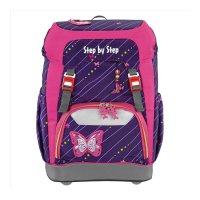
Tip: Quality school bags are usually equipped with reflective elements visible from all sides, i.e., on the front panel, on the sides, and on the shoulder straps.
Which reflective elements to use for maximum visibility?
The basis is a combination of different elements. It is not just about a reflective vest. Ideally, you should wear clothing in bright, fluorescent colors, such as neon yellow, orange, or pink. These colors absorb UV radiation and emit it as visible light, making you visible even in daylight or at dusk. Reflective materials then come into play when light from external sources (such as car headlights) hits them and reflects it back to its source. For maximum safety, you should combine these two types of materials.
Tip: Wear a jacket in a neon color and supplement it with a reflective band on your arms and legs. This ensures your visibility both during the day and in total darkness.
Reflective materials and their properties
Most modern reflective elements use a technology called retroreflection. What does that mean? Simply put, light that hits the material is reflected back to the source at almost the same angle, rather than scattered in all directions as with ordinary materials. This is achieved using tiny glass beads or microprismatic structures. These materials are incredibly effective and form the basis of all high-quality reflective vests and bands. It is therefore essential to choose products that are labeled as retroreflective.
Care for reflective elements
To ensure your reflective elements maintain their effectiveness, it is important to take proper care of them.
How to wash reflective clothing correctly? Always follow the instructions on the label. Usually, washing at a low temperature (up to 40 °C) and without the use of fabric softener, which could damage the reflective layer, is recommended. Dry them naturally, avoid the dryer, and do not iron directly over the reflective surfaces. Also, regularly check the condition of the elements. If the reflective layer is peeling or worn, it is time for a replacement. The lifespan of reflective materials is limited, and although it may not seem so at first glance, they lose their properties over time.
Frequently Asked Questions (FAQ)
- Are reflective elements mandatory in the city too?
In a municipality, they are not mandatory by law unless you are moving on a road during low visibility where there is no sidewalk. Nevertheless, their use is strongly recommended for your maximum safety. - What is the difference between a reflective vest and reflective clothing?
A reflective vest is a separate piece of clothing worn over outer garments. Reflective clothing has reflective elements already integrated directly into the design (e.g., reflective stripes on jacket sleeves). - Do reflective elements work in daylight?
Reflective materials themselves do not work in daylight. Their effectiveness lies in reflecting light that hits them, which happens mainly at night. However, if they are combined with fluorescent colors (yellow, orange), you are better visible even during the day. - What is a fluorescent color and how does it differ from a reflective material?
A fluorescent color (e.g., neon yellow) absorbs invisible UV radiation and emits it as visible light, so you are better seen at dusk or during the day. A reflective material reflects light that hits it back to the source. - Which reflective elements are best for children?
The ideal ones are those that children like and that they are happy to wear. This can be a backpack with integrated elements, reflective pendants in the shape of animals, or bands with colorful patterns. - Where exactly to place reflective elements on a backpack?
Place them on the parts that are most exposed to the view from cars, ideally on the straps and the bottom parts of the backpack so that they are not covered by your body. - How often should I check the condition of my reflective elements?
Regularly. After every wash, check if the reflective layer is peeling or cracking. If you are not sure, you can test it with the flash of your phone's camera. - Can I make reflective elements myself at home?
Yes, there are reflective bands and iron-on patches that you can buy and attach to clothing. However, always prefer certified products with verified reflective properties. - Is a reflective vest mandatory for a cyclist at night?
For a cyclist, a vest is not mandatory by law if their bike is properly equipped with front and rear lights and reflectors. However, for maximum safety, it is highly recommended. - What is the penalty for not using reflective elements?
Not using mandatory reflective elements can be considered an offense and you can receive a fine of up to 2,000 CZK. However, the fine is the least of it. The main consequence is endangering your own life.
Wear reflective elements and help prevent accidents
Investing in quality reflective elements is an investment in your safety. Never underestimate the risks of moving on the road during low visibility. Whether it is a small reflective pendant on your bag, an elegant reflective bracelet, or a professional reflective vest, every piece counts. Remember that even if the law does not impose an obligation to wear reflective elements in a municipality, your common sense should tell you that it is the least you can do for your protection. In the Bagalio.eu e-shop, you will find a wide selection of backpacks with reflective printing and elements that will help you be more visible and safe. Think about your visibility wherever you go.