


Don't want to or can't eat just anything? In today's world full of possibilities, this is fortunately usually not such a problem. However, when you find yourself several thousand meters above the ground, your dietary restrictions can make your life quite difficult. Preventing this is easy, though; all it takes is a little thoughtful planning or perhaps some good communication skills.
In-flight meals are not what they used to be
Long gone are the days when every flight was made more pleasant by a box full of all sorts of goodies, which smiling flight attendants (or stewards) would hand out approximately halfway through the flight. At least, that's how I remember vacations from my childhood. Whether we were flying for less than two hours to Athens or a bit longer to Tunisia, there was always in-flight refreshment, and it was truly abundant and usually warm.
Today, however, carriers have significantly rethought their approach in the interest of cost-cutting. During shorter flights, you get at most a small snack in the form of a baguette with two slices of salami, and if you want something more, you have to pay extra. For longer flights (usually over three hours), warm refreshments are of course still provided – though their quality and taste are a matter for another debate. More importantly, almost without exception, their foundation is meat and foods containing common allergens.
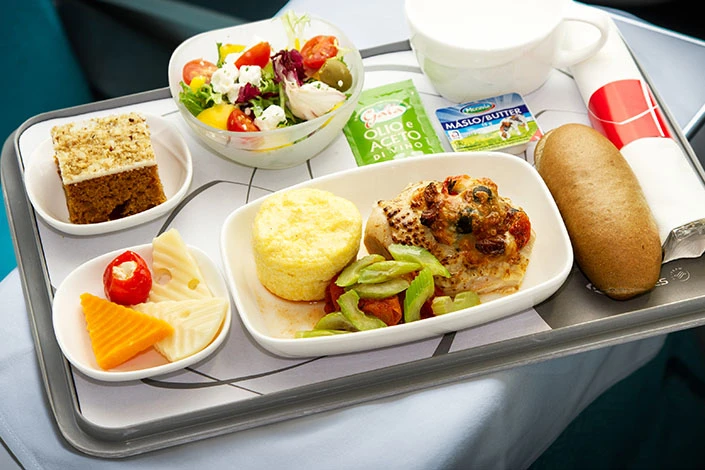
Don't leave it to chance
If you don't want to fast involuntarily on the plane or risk health complications, you essentially have two options. The first is to order a meal that meets your requirements in advance. You need to contact the customer service of the specific airline (or travel agency) and inquire about the options offered. To be safe, specify exactly which ingredients you avoid, and do not rely on the airline employee automatically associating terms like celiac or vegan with a list of potential threats. Do this well in advance and, when being served, double-check that the meal truly meets the criteria you announced.
I asked my acquaintances about their experiences, and I was pleasantly surprised that they were mostly positive:
- Ryanair, Italy–Czech Republic: "Complete satisfaction with the vegan ratatouille."
- British Airways, flight to the USA: "Excellent vegan meal upon request! They already offer one meat and one vegetarian dish as standard."
- Emirates, Czech Republic–Dubai: "The 'strict vegetarian' option was the most suitable for me. Breakfast included butter (which I removed), the main course was vegan. Great satisfaction, the food was more varied than the classic one."
- Lufthansa, flight to Singapore: "Ordering a vegan meal in advance was no problem. It tasted okay – breakfast was good, I remember there was fruit, but for lunch, there was some soy sausage in tomato sauce, and that wasn't much."
- "With all airlines that offer food, it was completely fine, just one click over the internet (CSA, Etihad, Emirates,...), only with China Eastern Airlines did I spend about three days figuring out what to do, and in the end, I had to call Paris."
- Malaysia Airlines: "On the way there, the vegan meal was without problems; on the way back, they apologized that they couldn't find the request."
- Emirates, Vienna–Dubai–Bangkok and back: "Completely fine, the food was perfect, as if I had cooked at home. From Bangkok to Krabi and back, we flew LionAir, I think, and I was unlucky with the vegan meal there – it's a low-cost carrier. But the flight was short, so we bought our own food for the plane and solved it that way."
- Korean Air, Australia–Seoul–Prague and back: "Solved with one click, I always got my food first, and it was very good. Only one of the courses was rice and 'shrimp', but they assured me it was some kind of substitute. :-)"
- Austrian Airlines, Vienna–Zurich: "There was only a sandwich for a snack, and there was no choice at all, just ham or cheese."
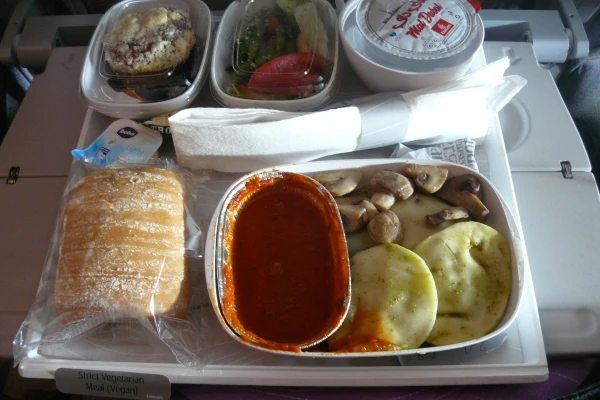
And how much does such a service cost? For example, with Travel Service, you will pay 390 CZK for a hot meal (if it is not included in the ticket price), but a special meal can only be requested for flights over 3 hours. (You can specifically order vegetarian, gluten-free, cholesterol-free, low-sodium, Muslim, lactose-free, or diabetic-friendly meals. Orders can be placed at most three working days before departure.)
CSA expressed a similar view on the issue: a special meal can only be requested on long-haul flights or in business class at least 24 hours in advance. Detailed information can be found directly on the carrier's website.
Feed yourself from your own supplies
Because the most reliable helping hand is located at the other end of your arm, the surest way is to prepare your own food. A snack in a box or bag should not be a problem as long as it cannot be classified as a liquid. So forget about soups, smoothies, or cocktails. Jam (in quantities larger than 100 ml), yogurts, pudding desserts, or anything with sauce could also be problematic.
However, you should be able to bring all sorts of sandwiches, pasta salads, pastries, or savory pies without any unnecessary hassle. Always keep a piece of fruit and vegetables, muesli or raw bar, and similar emergency supplies on hand that do not spoil quickly and will come in handy even after arrival.

Ideas for a gluten-free and lactose-free vegan menu suitable for on-board:
- salad with favorite vegetables, chickpeas, millet, olives, and spices
- gluten-free quiche with tofu and spinach filling
- wrap made from corn tortilla (filling, for example, avocado, vegetables, and beans)
- toasts from gluten-free bread
- buckwheat with grated carrots, apple, cranberries, nuts, and cinnamon

Suitable snacking between meals:
Final tip: Not just for the plane, you might find the practical Built salad bowl with a neoprene sleeve useful, which keeps food pleasantly warm for up to 4 hours.
Have you dealt with a similar situation yourself? Share your experiences with us.


