


Native mountaineers and mountain goats at heart will likely shake their heads in disbelief when reading the title, wondering why anyone would bother writing about such obvious things that, in their opinion, should already be encoded in one's DNA. However, not everyone is raised on mountain peaks, which is why we have decided to write down a few of the most important things that you should definitely not miss in your backpack. Above all, keep in mind that every extra kilo you load into your backpack before the hike feels like five extra kilos in the mountains.
The aforementioned experienced mountaineers will surely remember what it was like when they were just starting with hiking and trekking. How they struggled with what to take with them and how only time and experience taught them that they actually didn't need half of the things. So, what should you pack for a multi-day trek where you should easily get by with a 20–40l backpack?
Mountain fashion show
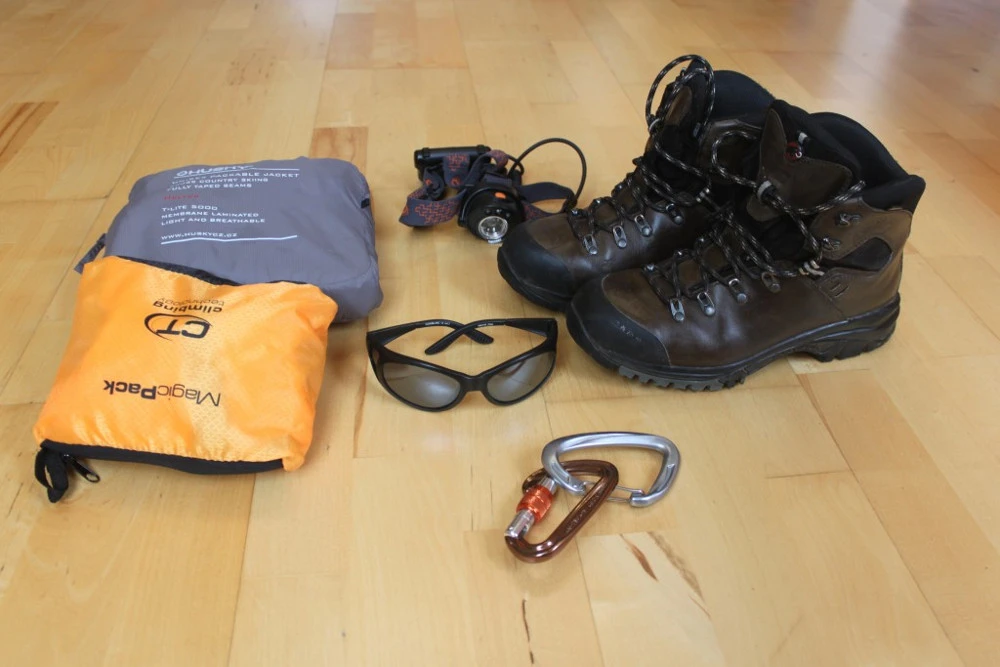
Grandpa always said that with good footwear, you can walk through a puddle. And shoes are probably the biggest stumbling block in the mountains. The practical thing is that you will have them on your feet most of the time, so they won't take up space in your backpack. Quality (and most importantly, broken-in) footwear is essential in the mountains; you wouldn't get very far in flip-flops or stylish high heels. It pays to invest not only money but also time in choosing hiking boots. If you choose correctly, you will gain a companion for several years. If not, you will gain several companions immediately. Believe me, if you get blisters on the first day, your vacation in a natural paradise will turn into hell.
Besides shoes, you will also need some clothing. There are usually no tropical temperatures in the mountains, so you won't get by with just a swimsuit like at the seaside. It is therefore good to pack thermal underwear in your backpack, as the weather in the mountains can change from minute to minute. Underwear and socks are a must, as you can never have enough of them. It is good to have one pair of long and one pair of short pants, because if you get wet, you still have something to change into. A short-sleeved and long-sleeved t-shirt is a necessity (if you have quality thermal underwear, you don't need more). Don't forget that you will bitterly curse every extra gram up there.
In case of really bad weather, you need to have one more, i.e., a middle thermal layer, so pack a sweatshirt as well. In the early morning or late night hours in the mountains, you will also appreciate a thin hat (it doesn't have to be a fur hat) and gloves, even in summer. And if, like me, rain always brings you luck, then definitely pack a waterproof jacket that will also serve as a windbreaker. A rain cover for your backpack can also come in handy – it weighs almost nothing but keeps your things dry.
Other essentials
You should definitely head to the mountains with a travel first aid kit. In nature, you are usually quite far from the nearest medical help, so it is good to have the most basic supplies with you at all times. You can assemble the first aid kit yourself or rely on professionals and buy complete travel first aid sets. We can recommend, for example, the well-equipped LifeSystems Trek First Aid Kit designed specifically for treks. It won't hurt to throw in an extra bandage, which will help deal with sprained ankles and strained knee ligaments when climbing on rocky terrain.
Your backpack should also contain sunscreen with a higher protection factor. Just like on the water, the sun beats down more intensely at higher altitudes. Therefore, also think about sunglasses or some headwear. Getting sunstroke right at the beginning will definitely not contribute to a peaceful enjoyment of your vacation. Even though you will be in nature and don't have to worry too much about your appearance, basic toiletries should have their place in every backpack. Adapt the contents of your toiletry bag to your preferences, the location, and the nature of your vacation – whether you will be sleeping under the stars or in hotels where there will be a shower and other amenities of civilization. Under the stars, you probably won't need shower gel, shampoo, or conditioner, and you will get by with ordinary soap and a stream, a damp towel, or wet wipes. :)
Man does not live by air alone

If you are heading on a longer trek into mountains untouched by civilization, where you are taking a stove and food for several days, you definitely need to reconsider the dimensions of your backpack. Food supplies and cooking equipment usually take up a substantial part of it. This is a very individual item on the packing list, so we will leave it open for everyone to decide what they need. However, we will continue to work with the assumption that you are not heading into the complete wilderness and will be solving most of your stomach's requirements in mountain huts and cabins. So, just throw in a can or ready-made meal, a sweet treat, muesli bars, or fruit.
Another important item that some might overlook is a water bottle. You can refill it during the hike in mountain streams, for which we recommend having a filter. You can use quality bottles for several years. You will definitely be satisfied with the Nalgene bottle brand, as well as with the proven Osprey, Deuter, or Camelbak water reservoirs. You can choose from various volumes, colors, and designs. It just depends on what suits you best.
TIP: It is advisable to add a little electrolyte or a pinch of salt to water from streams and similar natural sources; when sweating, the human body flushes out minerals that are not in pure water)
Don't go anywhere without a map
If you are going on vacation to places that are not so touristy, or if you want to avoid other tourists, definitely pack a map of the area you are heading to and a charged smartphone in your backpack. You can also download GPS navigation to your smartphone, so you don't have to carry any extra external one. At lower temperatures, the phone battery disappears at rocket speed, so definitely think about a power bank. And because we pack wisely, there will still be room in the backpack for a headlamp, whistle, and other essential treasures.
If you are also an enthusiastic tourist-photographer, you will also need space in your backpack for a camera in a protective waterproof case. Given the weight of large DSLRs and lenses, it is better for ordinary mortals to take a compact digital camera to the mountains or take photos directly on a mobile phone, which, when chosen correctly, takes very high-quality photos and is simultaneously compact and light enough.
What do you pack for the mountains? And what kind of backpack do you use? Share with us in the comments.
article update: May 2024


