


A backpack is your companion on every journey, accompanying you from the first step to the finish line. It is just as important as your shoes, as any discomfort can turn your trip into unnecessary agony. A sore back and shoulders, hard-to-reach gear, unnecessary extra weight, unsuitable features… these are just some of the many signs of a poorly chosen backpack. However, this can be easily avoided by asking a few simple questions before choosing a backpack for a trek or hike.
1) How big?
The first thing to consider when choosing a hiking backpack is its volume. Backpack size is a very individual matter, as everyone is used to taking a different amount of gear. It also depends on whether you will be able to replenish food and water during your hike. Therefore, I can only give you very approximate recommendations:
- A backpack up to 20 liters is suitable for shorter activities, sports, and walks.
- A range of 20 to 30 liters works well for day trips.
- A volume between 30 and 40 liters is a good choice for anyone who needs more items on a shorter trip or is heading out on a longer trip traveling light.
- A backpack from 40 to 60 liters finds its use on a shorter trek (a few days).
- A backpack over 60 liters is suitable for longer expeditions (more than a week).
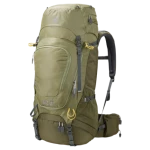
If you have multiple backpacks at home, the easiest way is, of course, to try filling a smaller one, and if it is not enough, reach for a larger one. However, if you are just about to buy a backpack and are unsure about the volume, I recommend taking all the things you will use on the trek, packing them into a plastic bag of a certain volume, and using that as a guide when shopping. However, it is better to count on a reserve, because packing things into a backpack is more difficult than into an empty and flexible bag.
And if you first need to clarify which items you will need on the trek, get inspired by the previous part of this series.
2) What kind of back system?
The next question concerns how the backpack will sit on your back. Every manufacturer has developed different types of back systems for their backpacks, so the issue cannot be generalized. However, it is possible to find certain analogies. First of all, back systems can be distinguished by height adjustability into:
Adjustable back system
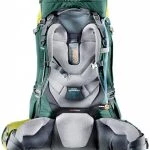
With the help of Velcro, loops, or another mechanism, you can usually adjust the distance between the hip belt and shoulder straps, thereby adapting the backpack to the height of your figure (or back length). These backpacks are more suitable for short or, conversely, tall figures. One backpack can also be used by multiple people of different heights.
Most large backpacks are equipped with an adjustable system. You can find it, for example, on the Deuter Aircontact 45+10.
Fixed back system
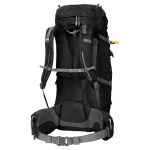
The distance between the hip belt and shoulder straps is unchangeable in this case and must exactly match the height of the figure. However, a fixed back system is somewhat more stable and rigid because the shoulder straps are sewn to the backpack, so no unwanted movement can occur.
This type of back system is featured on, for example, the Lowe Alpine AirZone Trail Camino 37:42. Here, the recommendation to try the backpack on before buying is especially important. However, if it fits you, it can work better in practice than a backpack with an adjustable back system.
Another possible distinction is based on the way the contact between the backpack and the back is solved:
Padding
The areas that represent the contact surface between the back and the backpack are padded. The padding is usually perforated for better ventilation and drying, but main ventilation is achieved by the backpack touching the back only in certain places (usually the lower back and shoulder blades).
You can see this type of back system, for example, on the Lowe Alpine AirZone Trail Duo 32 pack.
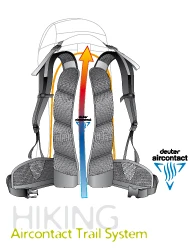
Mesh partition
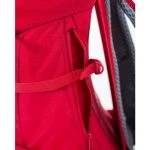
The back does not touch the backpack directly, but rather a flexible mesh that is attached at the bottom and top edges of the backpack. There is an empty space between the backpack and the mesh through which air can flow. This type of back system is the best ventilated (the back touches a minimal surface), but it does not suit everyone (for some body types, the mesh attachment can press into the lower back), which you will only find out by trying it on.
A good example of a backpack with a mesh partition is, for example, the Rab Aeon 35 Anthracite or the Lowe Alpine AirZone Trek 40.
Trying on the backpack
Whatever back system you choose, the main thing is that you feel comfortable in it. Therefore, thoroughly try on the backpack before buying. Follow these tips:
- The backpack must always be tried on filled with a load of similar weight to what you will carry on the trek. Only then will you know if anything is pressing on you. At our store, we will be happy to lend you weights and advise you on the correct adjustment of the back system and straps.
- You need to have the backpack on your back for some time. I also recommend moving around in the backpack for a while – try different types of movement that you will use on the hike (walking, climbing, using poles, etc.).
- Try different models from different brands. Every manufacturer creates their backpacks for a certain type of figure, and it often happens that one brand fits someone perfectly, while another does not.
- If you have a slim figure, I recommend trying narrowed or women's versions of backpacks, marked for example SL (Deuter), ND (Lowe Alpine, Rab), or Women.
- For tall figures, there are backpacks with extended backs (marked for example EL at Deuter). Of course, you can reach for backpacks with an adjustable back system mentioned above.
3) What should the backpack be able to do?
In third place comes the selection of various backpack features. Would you appreciate a single-compartment backpack where you have everything together, or two compartments that can be connected by unzipping a partition? Besides the top or bottom entry, will you use a front entry, which allows you to reach things stored in the middle part of the backpack? Do you want the backpack to be expandable (you can increase it by additional volume)? Do you prefer access via a zipper or a lid with buckles?
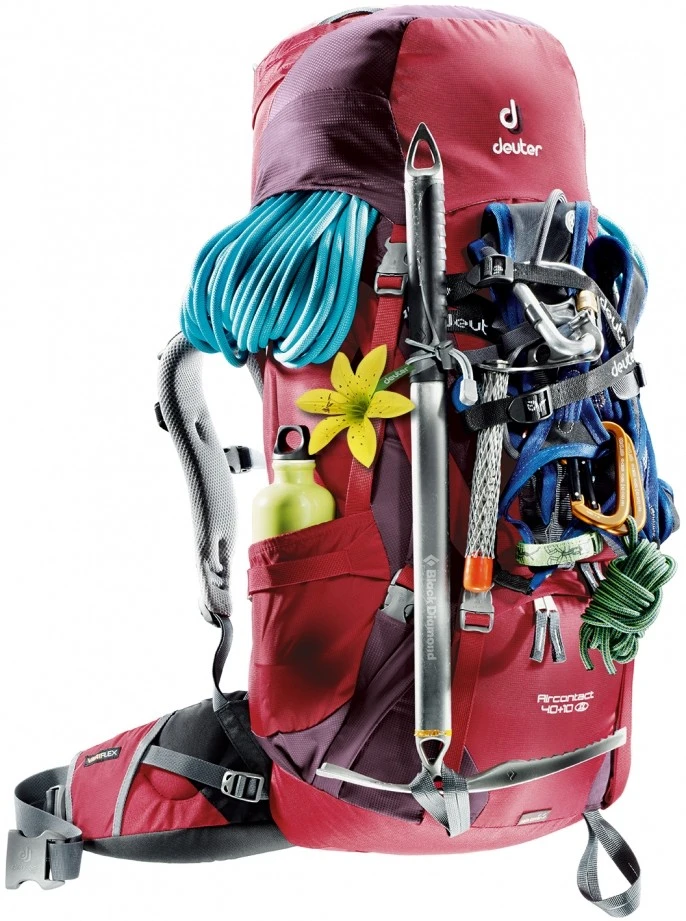
Will side pockets or mesh bottle pockets be useful, and if so, how big? Would you welcome external attachments and loops for trekking poles, an ice axe, or additional equipment such as a sleeping mat? Will side compression straps be useful for tightening the backpack when it is not fully filled? Should the backpack have a rain cover as standard equipment? And what about an integrated whistle, perhaps on the chest strap? These are just some of the many questions that can help you when choosing a backpack.
However, let's not forget one important aspect: you should like the backpack. It is not just about the appearance, but overall about "getting along well" with the backpack. And if you "fall in love" right away, then you can be sure that a pleasant journey awaits you. :-)
In the next part of the Step by Step series, we will introduce several tips on how to prepare for a trek.
You can also find other valuable information in the article about choosing a hiking pack in our Advice center.


